
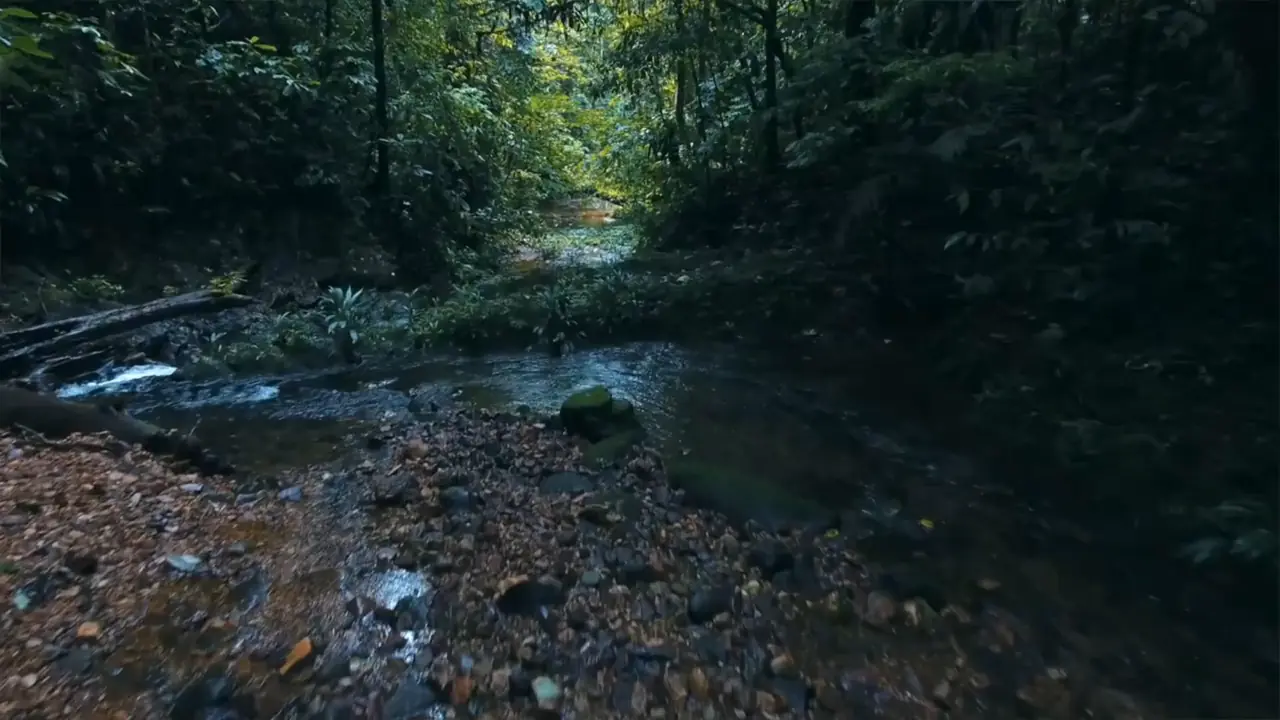
A stream at La Hesperia.
Fundación Tangaré / Questions
Frequently asked questions
About the Foundation, donations, our programs and how to reach the field site. If your question is not here, write to us.
The Foundation
What is Fundación Tangaré?
An Ecuadorian nonprofit foundation registered in 2009 with the Ministry of the Environment (Ministerial Agreement 003, RUC 1792190967001). We carry out research, conservation and environmental education in the cloud forest of the western Andes. More about us.
How is it related to La Hesperia?
La Hesperia is a family-run private reserve and working farm, and our main field site. The two are separate organizations that work together under an agreement: the reserve protects the land and hosts participants, and the Foundation carries out projects there and manages donations.
Who runs the Foundation?
Alexandra Hoeneisen is the executive director. She signs the certificates of participation and is a co-author of the capuchin study published in 2026.
Does the Foundation publish its work?
Yes. Published research and the inventories carried out at the field site are listed on our publications page.
Donations
How can I donate?
By card or PayPal through our secure PayPal page, or by bank transfer through Wise. See the donate page.
What is my donation used for?
Wildlife monitoring, reforestation and environmental education in the cloud forest. As examples: $40 plants a tree and cares for it for a year, $200 pays for a field trip for the local school, and $300 buys a camera trap with batteries and a memory card.
Will I receive a receipt?
We confirm every donation in writing. Donations are not tax-deductible.
Does La Hesperia receive donations?
No. Donations for conservation at La Hesperia are received and managed by Fundación Tangaré.
Research and volunteering
Which programs can I join?
Research and internships (4 weeks to 5 months, from $880 USD a month) and volunteering (1 week to 5 months, personalized quote). Both take place at La Hesperia.
Do I need experience?
Not for volunteering. Research placements are designed for students and people starting a career in biology, ecology, agronomy or a related field.
Can I design my own study?
Yes. You can run your own project with our supervision or join the monitoring already under way.
Why is there a fee if volunteering is unpaid?
The fee covers your stay: room, three meals a day, internet, transport from the highway and the team that guides your work.
Do I need to speak Spanish?
No. You can be supervised and coordinated in English. Many people use their stay to improve their Spanish.
When can I start?
Any Monday of the year, except during the closure from 23 December to 3 January. There are up to 16 participants at a time.
Travel, safety and daily life
Where is the field site?
La Hesperia is in Pichincha province, on the paved highway from Quito down to Santo Domingo (Km 58), roughly 90 km and 1.5 to 2 hours by car from the capital. We pick you up where the reserve’s road leaves the highway, and for an extra cost we can organize the ride from Quito or the airport. Please agree your arrival day with us in advance.
What is the climate like?
The site lies between 1,100 and 2,040 m, with temperatures of 16 to 30 °C and 2,000 to 3,000 mm of rain a year. It rains in every season.
Is it safe?
The reserve is private land with staff working there full time. A first aid station is kept on the property, staff hold wilderness first responder training, and Santo Domingo, an hour’s drive away, has the nearest hospital.
Do I need a visa or insurance?
Many passports allow a stay of up to 90 days in Ecuador without a visa; check the rules for yours. You must have international health insurance that covers you in Ecuador for every day of your stay.
What are the accommodation and food like?
Simple, clean shared rooms with hot water, and three home-style Ecuadorian meals a day, made partly with produce from the organic gardens. Vegetarian, vegan and other diets can be arranged in advance.
How fit do I need to be?
The trails are steep and often muddy. Fieldwork can mean 3 to 5 hours of walking a day, so you should be comfortable with hiking and physical work.