
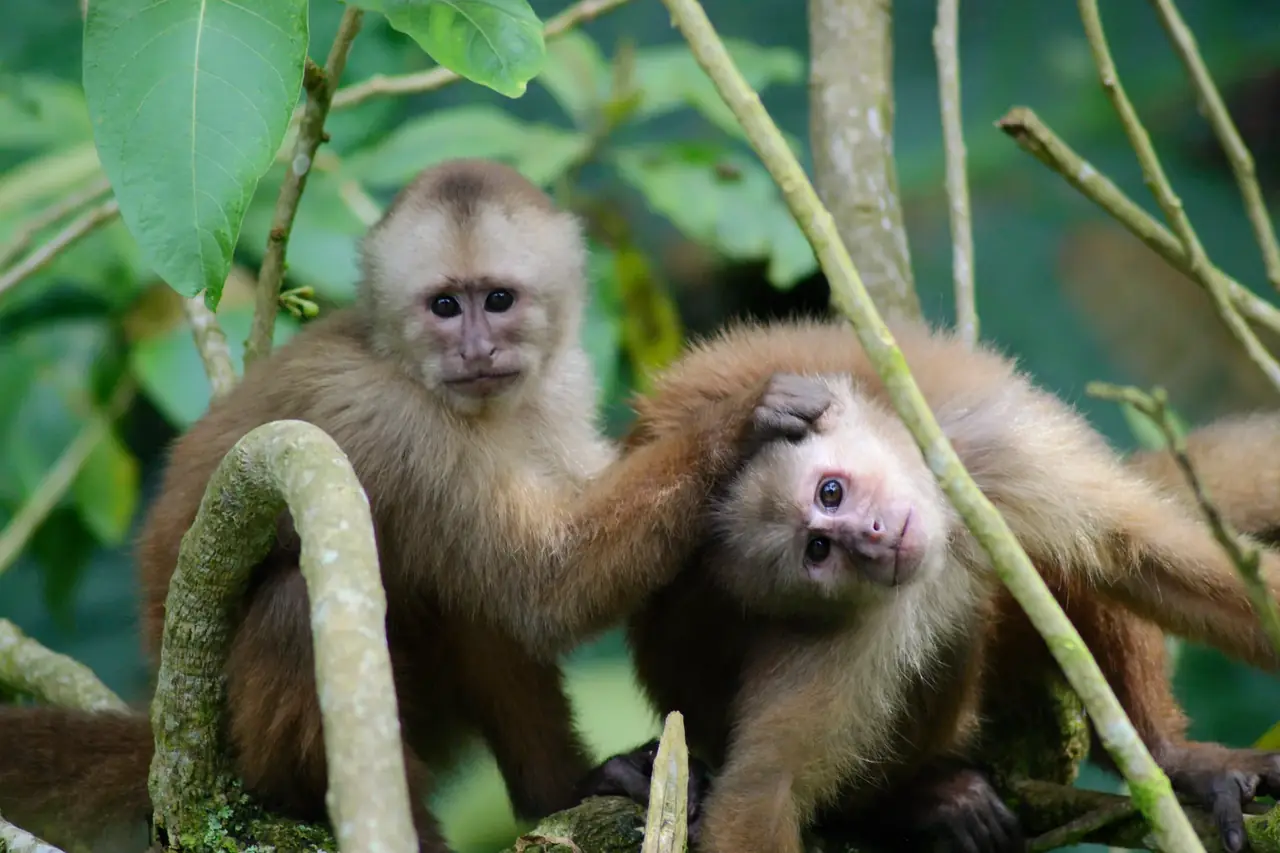
Ecuadorian capuchins at La Hesperia.
Fundación Tangaré / Ecuadorian capuchin
The Ecuadorian capuchin: research on a Critically Endangered primate
At least 4 groups of Cebus aequatorialis live in the forest where we work, and individual monkeys can be recognized. That makes it one of the few places where this species can be studied over the long term.
- Status
- Critically Endangered
- Range
- Western Ecuador and the far north of Peru
- At our field site
- At least 4 social groups
- Published research
- 1 peer-reviewed article (2026)
A primate running out of forest
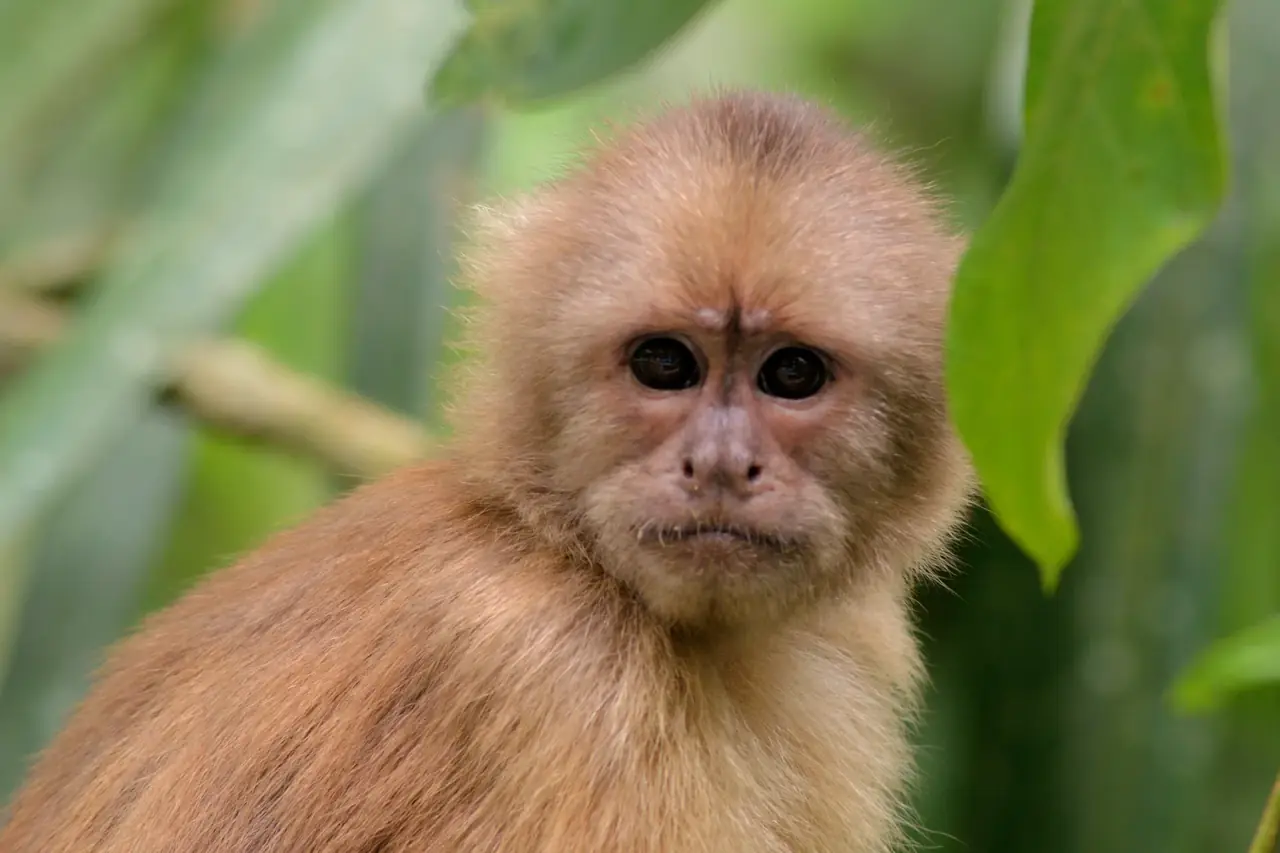
The Ecuadorian capuchin is a white-fronted capuchin found in western Ecuador and the far north of Peru. On the IUCN Red List it is Critically Endangered, one step from extinction in the wild, and it no longer lives in much of the area it once occupied.
Capuchins travel and feed as a group, and a group needs continuous forest to move through. That is why the Puma Biological Corridor, to which La Hesperia belongs, matters for them: it aims to keep the forest patches of the western Andes joined together.
The groups at La Hesperia
At least 4 separate social groups have been documented in the reserve, and researchers can tell individual monkeys apart by their faces and bodies. Groups are seen most often along the main trail.
Along with the Andean bear, the puma, the collared peccary and the tayra, the capuchin is a priority for monitoring at the site. Cameras, point counts and walks through the forest show how numbers change over time, which areas the monkeys use and how they interact with other species.
More than fifty years of continuous forest protection is the reason they are still here.
What the first study found
Fundación Tangaré is one of the institutions behind it.
The question
Behaviors such as yawning and scratching can spread from one animal to another, and this kind of contagion is thought to help groups stay coordinated. Scratching had been studied far less than yawning, especially in wild primates.
The work
For a master’s thesis in 2024, Nuria Hannaoui followed one habituated group of 16 capuchins at La Hesperia. The study was led by the Universitat de Girona with Fundación Tangaré, and Alexandra Hoeneisen, the Foundation’s executive director, is one of its authors.
The result
Capuchins were clearly more likely to scratch after seeing a groupmate scratch. Neither age, sex, rank nor the strength of social bonds changed that effect, which suggests an automatic response rather than one driven by friendship. No yawning was recorded at all during the study.
Why it matters
Evidence of behavioral contagion in New World monkeys is still scarce, and studies of wild groups in their own habitat are rarer still. The authors suggest that scratching may work as a kind of social glue, helping the group move, rest and feed in step.
Hannaoui, N. H., Amici, F., Hoeneisen, A., & Llorente, M. (2026). Behavioral contagion in wild Ecuadorian white-fronted capuchins (Cebus aequatorialis). American Journal of Primatology, 88, e70122. https://doi.org/10.1002/ajp.70122
Open access. Before publication, the results were presented at a congress on ethology and evolutionary ecology in Seville, Spain, in September 2025 (XIX National and XVI Ibero-American congress).
I studied behavioural contagion in a group of Ecuadorian capuchin monkeys, a species that is critically endangered. […] I learned about nature, I learned about Ecuador, and I learned so many things!
What we are doing now
Behavior and vocalizations
We record unusual behaviors and vocalizations of the capuchins, building a base of observations for future studies.
Camera traps
The same cameras that follow the forest’s carnivores also record the capuchins.
New studies
Students and researchers can join the primate work or design their own project with our supervision.
This work continues because people choose to support it
You can fund it with a donation, or take part in it as a researcher, intern or volunteer.