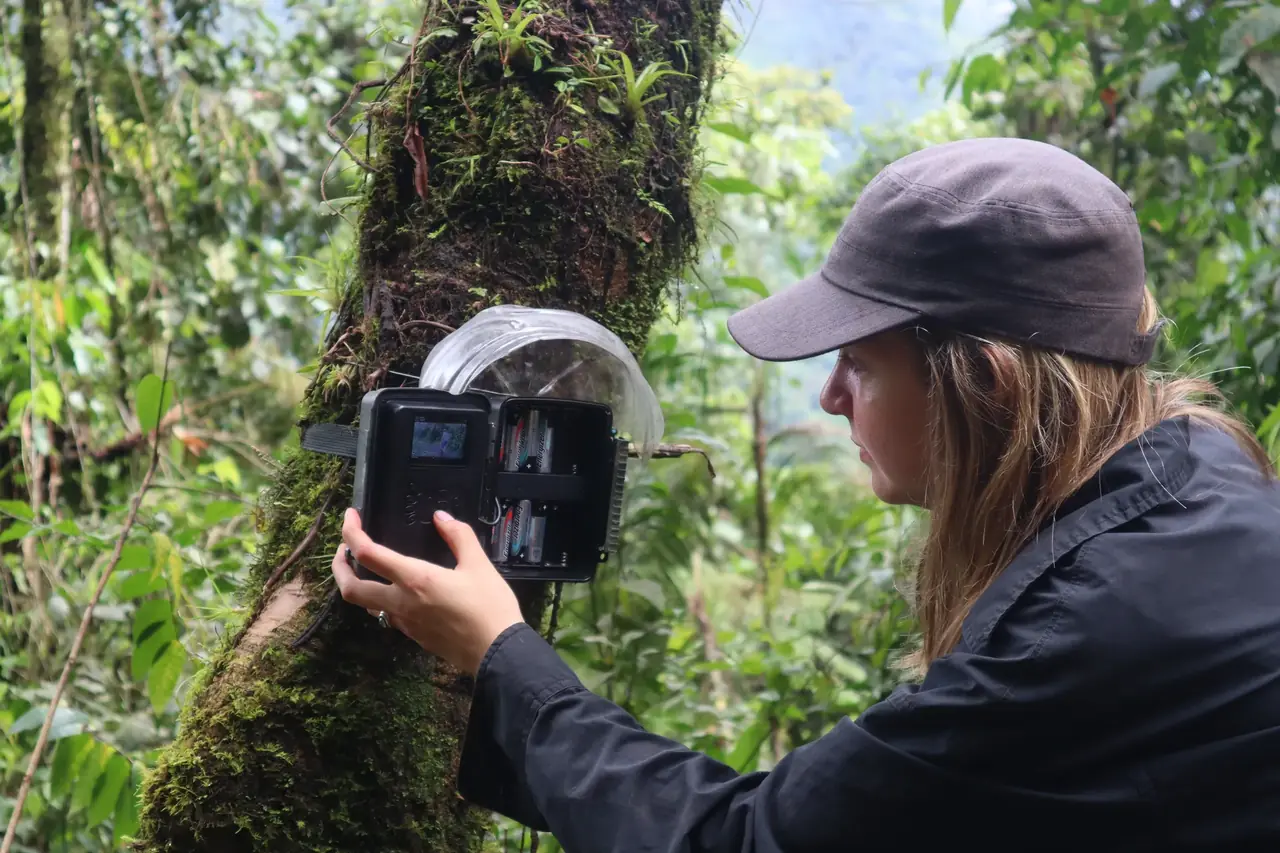
Setting a camera trap. La Hesperia.
Fundación Tangaré / Research and internships
Field research and internships in Ecuador’s cloud forest
Collect your own data in 700 hectares of protected forest where 297 bird and 43 mammal species have been recorded, among them a Critically Endangered primate. Join a monitoring project or design your own study, with supervision from our team.
- Duration
- 4 weeks to 5 months
- Cost
- From $880 USD a monthmeals and lodging included
- Start
- Any Mondayall year
- Places
- 16 at a timeso each person gets real supervision
Who it is for
Undergraduate and graduate students, and people in their first years of work, in biology, ecology, agronomy, environmental science or a related field.
It suits a thesis, a required internship or a first field season. Each participant receives a personalized work plan, built with our team around their goals and dates.
The program takes place at La Hesperia reserve, under the agreement between both organizations: you apply to and pay the Foundation, and you live and work at the reserve. It is the same program described on La Hesperia’s website.
What you can work on
These are examples. Other options depend on the season and on your interests.
Priority wildlife
Monitoring cats, including the clouded tiger cat (Leopardus pardinoides), and primates such as the Ecuadorian capuchin (Cebus aequatorialis), with camera traps and field surveys.
Holistic livestock management
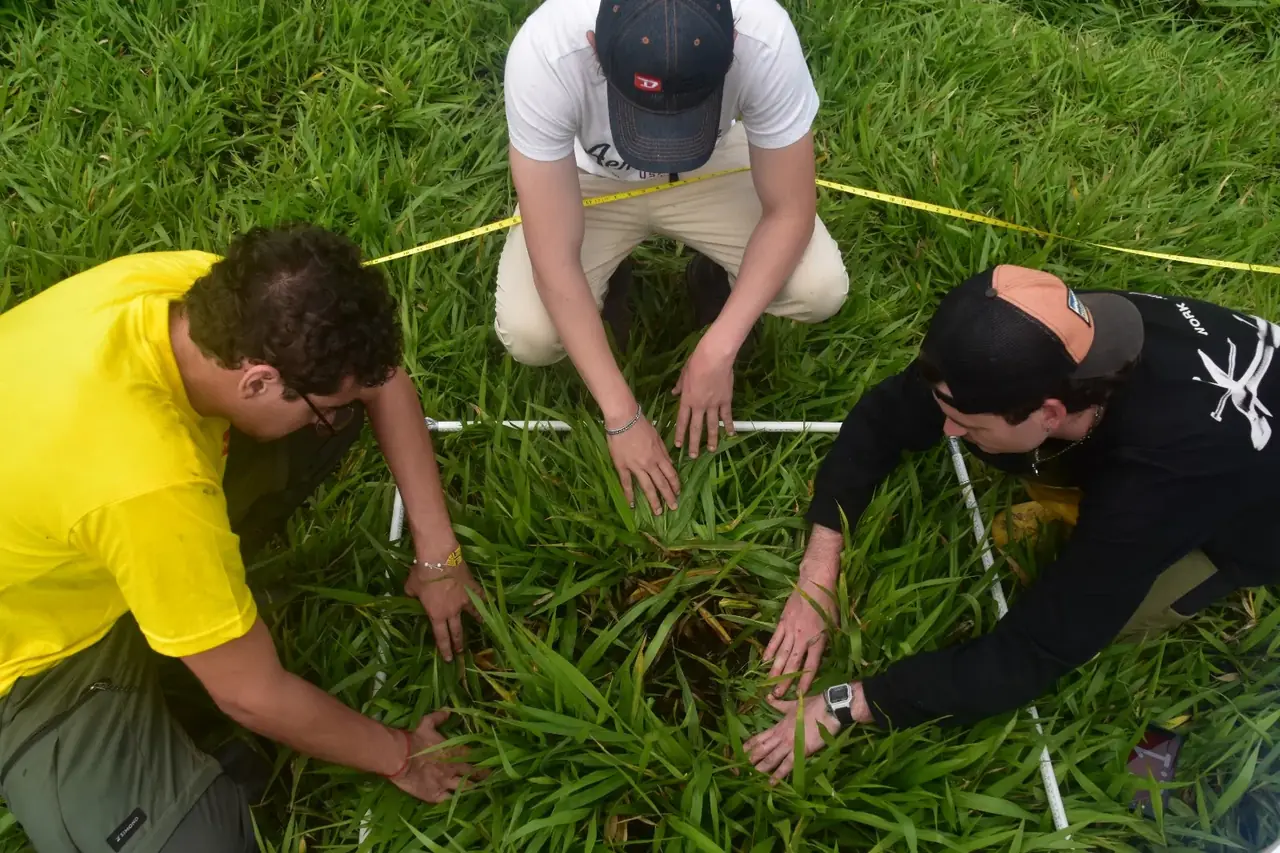
Studying how planned grazing affects pasture and soil on La Hesperia’s working farm, next to the forest.
Grant writing and development
Contributing to proposals that fund conservation work.
Your own project
Design and run an independent study with our supervision. The species lists and survey results for the site are published on our biodiversity page.
Open questions
The 2025–2026 surveys left clear gaps: bats, small mammals, amphibians above 1,800 m and canopy epiphytes all have species still to be recorded.
See all programs and projects · Species lists and survey results · Doing your thesis here
What you take home
Publishable field data
Data from a globally important area for biodiversity, strong enough to support a thesis, a paper or a grant application.
A work plan built around you
Before you arrive we agree on what you will work on, shaped by what your university asks of you, the time you have and the organisms you want to study.
Field skills
Setting and reading camera traps, mapping with GPS, recording behavior and keeping clean, usable data, practiced every day in the forest.
Access to the whole reserve
An elevation gradient from 1,100 to 2,040 m that crosses three types of ecosystem.
A network
Introductions through the Foundation to conservationists and environmental professionals.
A certificate
A certificate of participation that documents your work, signed by Alexandra Hoeneisen, Executive Director of Fundación Tangaré.
From a past researcher
In 2024 I was in La Hesperia conducting my master’s thesis. I studied behavioural contagion in a group of Ecuadorian capuchin monkeys, a species that is critically endangered. I enjoyed it so much, learned a lot about field research, and we also learned many things about the monkeys! […] I 100% recommend this experience.
Participants in the program have come from: Universitat de Girona, University of Bristol, University of British Columbia, University of Michigan, University of Wisconsin, Boston University, Deakin University, University of Kent, Czech University of Life Sciences, HAS University, Van Hall Larenstein University of Applied Sciences, Kalø Organic Agricultural College, University of Berlin, School for International Training, Universidad San Francisco de Quito (USFQ).
We can put you in touch with a past participant before you decide.
Conditions
| Duration | 4 weeks to 5 months |
|---|---|
| Start dates | All year, arrivals on Mondays |
| Closed | 23 December to 3 January |
| Cost | From $880 USD per month (shared room) |
| Languages | English and Spanish |
| Group size | Up to 16 individual participants in shared rooms; organized groups of up to 20 |
| Payment | To Fundación Tangaré, by PayPal or Wise |
| Insurance | International medical insurance is required |
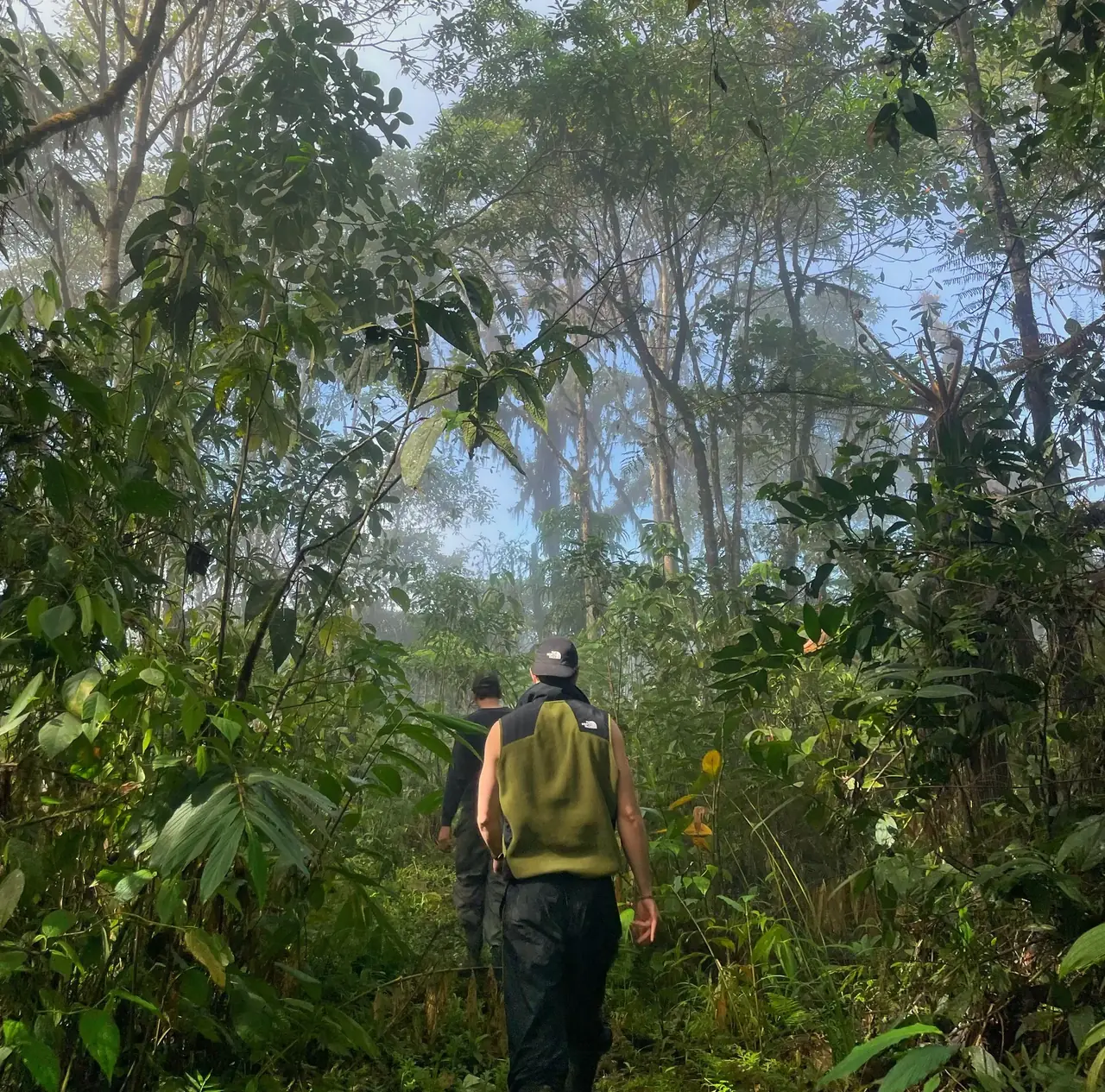
| Fitness | Moderate. Fieldwork means 3 to 5 hours of walking on steep, muddy trails |
Included
- Accommodation in shared rooms with hot water
- Three meals a day; vegetarian, vegan and other diets on request
- Internet access
- Transport between the highway and the reserve on arrival and departure
- Personalized work plan, mentorship and supervision
- Certificate of participation
- Access to all trails and habitats of the reserve
- Activities: a chocolate and coffee tour, two Ecuadorian cooking workshops, weekly talks and a guided hike every 15 days
Not included
- International flights
- Visa fees
- International medical insurance (required)
- Transport from Quito or the airport, which we can help arrange at extra cost
Where your fee goes
Your stay and supervision
The fee covers your stay at La Hesperia (shared room, three meals a day, internet and transport from the highway) and the supervision and work plan provided by our team.
The Foundation’s programs
Fundación Tangaré receives the fee. What remains after the costs of your stay funds its conservation, research and education programs. As a nonprofit foundation it does not distribute profits: all of its income is used for its mission.
Scholarships are available in some cases, depending on the needs of the reserve. Ask us.
The field site
Field site record: La Hesperia
- Locality
- Km 58, Vía Aloag–Santo Domingo, Pichincha, Ecuador
- Elevation
- 1,100–2,040 m
- Protected forest
- 700 hectares, protected since 1971
- Setting
- Toachi-Chiriboga Key Biodiversity Area, where the Tropical Andes and Tumbes-Chocó-Magdalena regions meet
- Ecosystems
- Evergreen piedmont forest, evergreen lower montane forest and montane cloud forest
- Climate
- 16–30 °C; 2,000–3,000 mm of rain a year
- Birds recorded
- 297 species
- Mammals recorded
- 43 species
- Amphibians and reptiles
- 52 species
- Plants
- 2,000+ species (estimate)
Records kept by La Hesperia reserve. Species counts grow as monitoring continues.
More about the forest and its wildlife
How to apply
Send your application
Fill in the form below with your research interests and preferred dates, and a link to your CV.
Interview
We schedule a call to talk about your goals and agree on what your stay will involve.
Confirm your stay
We prepare your work plan and send a packing list and travel guidance.
Application
contact@tangarefoundation.org
Common questions
Do I need to speak Spanish?
No. Mentorship and coordination are available in English. Local staff may not speak English, and many participants pick up Spanish in daily life.
What equipment should I bring?
We have basic field equipment for ongoing projects. For specialized research, bring your own. We send a packing list adapted to your work.
Can I design my own project?
Yes, with supervision and guidance from our team. You can also join an ongoing monitoring project.
Is it safe?
The site has a first aid station and staff with wilderness first responder training; Santo Domingo, an hour away by car, has the nearest hospital. You need international medical insurance.
Do I need a visa?
Many passports allow up to 90 days in Ecuador without a visa. Check the rules for yours before you travel.
Ready to plan your field season?
Send your application and we will arrange a call to talk about your project and your dates. Places are limited to 16 participants at a time.